The Art of Wood Joinery: Traditional Furniture Joints Explained
The Foundation of Fine Craftsmanship
Behind every piece of exceptional furniture lies an often-hidden element that determines its strength, longevity, and quality: the joinery. Wood joints are where craftsmanship meets engineering, where aesthetic beauty intersects with structural integrity. These connections—invisible in the finished piece or proudly displayed as design features—tell the story of a maker's skill and dedication to their craft.
At NOIR.DESIGN, our approach to joinery reflects our commitment to traditional techniques and lasting quality. While our signature steam-bending method creates continuous grain flow that eliminates many conventional joints, understanding traditional joinery helps appreciate why certain construction methods endure through centuries.
Why Joinery Matters
The quality of furniture joints directly impacts:
- Structural integrity: How well the piece withstands stress and daily use
- Longevity: Whether it lasts years or generations
- Aesthetic appeal: Visible joints can enhance or detract from design
- Repairability: Some joints allow for disassembly and repair
- Value: Fine joinery distinguishes heirloom pieces from disposable furniture
1. Dovetail Joints: The Gold Standard
Dovetail joints represent the pinnacle of traditional woodworking joinery. These interlocking wedge-shaped connections are revered not only for their exceptional strength but also for the visual testimony they provide to a craftsman's skill.
How Dovetail Joints Work
The joint consists of two interlocking components:
- Tails: Wedge-shaped projections that fan out like a dove's tail
- Pins: Corresponding wedge-shaped recesses that receive the tails
The wedge shape creates a mechanical lock that resists pulling forces. As stress is applied, the wedges tighten rather than separate, making dovetails incredibly strong without requiring glue or fasteners (though glue is typically added for extra security).
Types of Dovetail Joints
Through Dovetails: Visible from both sides, showcasing the craftsmanship. Often used in high-end drawer sides where the joint becomes a design feature.
Half-Blind Dovetails: Visible from one side only, with pins concealed. Perfect for drawer fronts where you want strength without visible joinery.
Sliding Dovetails: One piece slides into a dovetail-shaped groove in another, excellent for shelving and case construction.
Applications: Premium drawer construction, high-quality cabinets and case goods, jewelry boxes and fine storage pieces
2. Mortise and Tenon Joints: Ancient and Reliable

Mortise and tenon joints are among the oldest and most versatile woodworking connections, dating back thousands of years. Found in ancient Egyptian furniture and medieval timber framing, this joint has proven its worth across millennia.
How Mortise and Tenon Joints Work
The joint consists of two components:
- Tenon: A protruding rectangular tongue cut on the end of one piece
- Mortise: A corresponding rectangular hole or cavity cut into another piece
The tenon fits snugly into the mortise, creating a strong mechanical connection that's typically reinforced with glue and sometimes pins or wedges.
Variations
Through Mortise and Tenon: The tenon passes completely through the mortise and is visible on the opposite side. Often wedged for extra strength and visual interest.
Blind (Stopped) Mortise and Tenon: The mortise doesn't pass through, hiding the joint completely. Provides clean aesthetics while maintaining strength.
Haunched Mortise and Tenon: Features a shoulder that prevents twisting, ideal for frame construction.
Wedged Mortise and Tenon: Wedges driven into the tenon expand it within the mortise, creating an incredibly tight, permanent connection.
Applications: Chair and table leg connections, door and window frames, bed frames and headboards, any application requiring strong right-angle connections
3. Half-Blind Dovetail Joints: Hidden Strength
Half-blind dovetails combine the exceptional strength of dovetail joinery with a more discreet appearance, making them ideal for applications where you want strength without visible joinery.
The tails are cut into one piece and visible from the side, while the pins are cut into the other piece but stop short of passing through, remaining hidden from the front. When assembled, the joint appears as a clean, uninterrupted surface from one direction while showing the characteristic dovetail pattern from the side.
Applications: High-end drawer fronts (most common use), cabinet face frames, anywhere you want dovetail strength with a clean front face
4. Biscuit Joints: Modern Efficiency
Biscuit joints represent a more modern approach to joinery, developed in the 1950s. While not as traditional as dovetails or mortise and tenon, they offer practical advantages for certain applications.
Compressed beech wood "biscuits" (football-shaped wafers) are inserted into matching slots cut with a specialized biscuit joiner tool. When glue is applied, the biscuits swell, creating a tight, strong connection.
Applications: Edge-to-edge panel glue-ups (tabletops, wide boards), mitered corner reinforcement, cabinet case construction, aligning boards during glue-up
Advantages: Fast to execute, good alignment, adequate strength for many applications
Limitations: Not as strong as traditional joinery, requires specialized tool, less suitable for heirloom pieces
5. Tongue and Groove Joints: Seamless Surfaces
Tongue and groove joints excel at creating flat, seamless surfaces from multiple boards while allowing for wood movement—crucial for preventing warping and cracking.
One board features a protruding "tongue" along its edge, while the adjacent board has a corresponding "groove." The tongue fits into the groove, creating a flush surface while allowing boards to expand and contract with humidity changes.
Applications: Hardwood flooring (most common use), wall paneling and wainscoting, tabletops and wide panels, anywhere you need to join boards edge-to-edge
Why they excel: Allows expansion/contraction without gaps, keeps boards flush and level, increased glue surface area, creates continuous surfaces
6. Dowel Joints: Simple and Effective
Dowel joints use cylindrical wooden pegs (dowels) to align and connect two pieces of wood. While simpler than dovetails or mortise and tenon, properly executed dowel joints provide adequate strength for many applications.
Matching holes are drilled in both pieces to be joined. Wooden dowels, typically with spiral grooves to allow glue and air to escape, are inserted into the holes with glue, creating the connection.
Applications: Cabinet construction, shelving and bookcase assembly, modular furniture (allows disassembly), edge-to-edge panel joints
Advantages: Relatively easy to execute, no visible hardware, allows disassembly if unglued
Limitations: Requires precise drilling, not as strong as traditional joinery, less suitable for high-stress applications
The NOIR.DESIGN Approach: Steam-Bending as Joinery
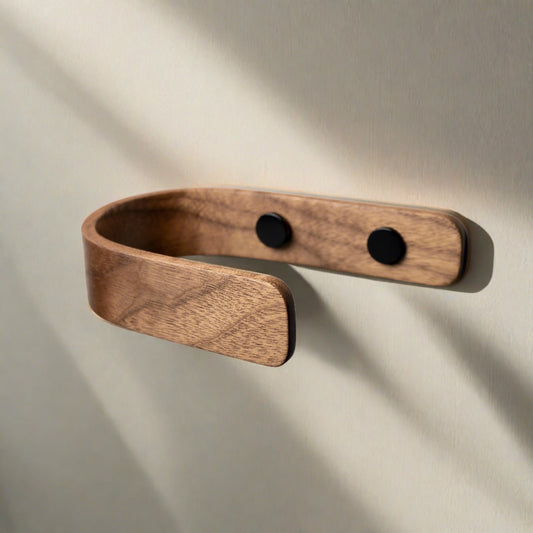
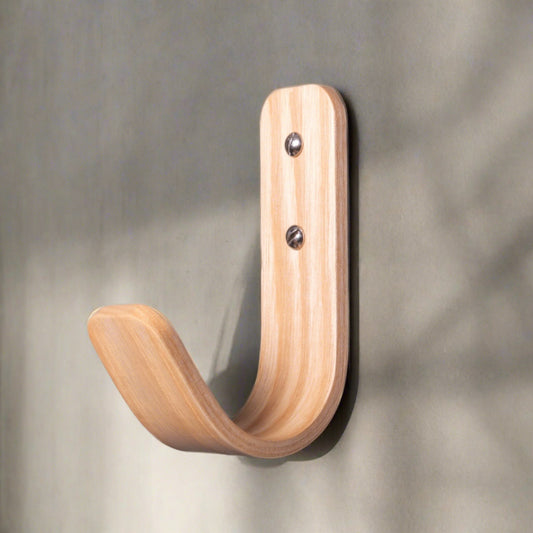
While traditional joinery techniques are remarkable, our signature steam-bending method offers unique advantages by eliminating many joints entirely.
Continuous Grain Flow
Steam-bending allows us to create curved forms from single pieces of wood, maintaining continuous grain throughout. This approach:
- Eliminates weak points where joints might fail
- Creates stronger structures than conventionally joined pieces
- Showcases uninterrupted wood grain beauty
- Reduces the number of potential failure points
While steam-bending forms the foundation of our wall hooks, watch stands, and coat racks, we do employ traditional joinery techniques where appropriate, favoring mortise and tenon joints for their proven strength and longevity.
Evaluating Joint Quality
When assessing furniture quality, examine the joinery:
Signs of Quality Joinery
- Tight fit: No gaps between joined pieces
- Smooth surfaces: Joints flush with surrounding wood
- Consistent spacing: In dovetails, evenly spaced tails and pins
- No visible glue: Excess glue cleaned before drying
- Proper alignment: Grain patterns flow naturally across joints
Red Flags
- Visible gaps or misalignment
- Excessive glue squeeze-out
- Staples or nails in place of proper joinery
- Particle board or MDF in structural joints
- Joints that feel loose or wobbly
Joinery and Furniture Longevity
The connection between joinery quality and furniture lifespan is direct:
Poor joinery: Furniture that lasts 5-10 years before joints fail
Adequate joinery: Furniture that serves 20-30 years with care
Exceptional joinery: Heirloom pieces that last generations
Traditional joints like dovetails and mortise and tenon, when properly executed, can last centuries. Museums worldwide display furniture with original joinery intact after hundreds of years.
The Hidden Art of Craftsmanship
Fine furniture joinery is often hidden, visible only to those who know where to look. Yet it's these unseen connections that determine whether a piece becomes a treasured heirloom or ends up in a landfill.
At NOIR.DESIGN, our commitment to quality extends to every connection, every joint, every point where wood meets wood. Whether through traditional joinery techniques or our signature steam-bending method that eliminates joints entirely, we ensure that every piece is built to last for generations.
The next time you admire a piece of fine furniture, take a moment to appreciate the joinery—the hidden craftsmanship that makes beauty possible and ensures it endures.
Explore our collection of handcrafted watch stands, desk accessories, and wall hooks, each featuring steam-bent construction that creates strength through continuous grain flow. Every piece is handcrafted in England using traditional techniques refined for modern excellence.