The Science of Hardwood Strength: How We Test and Select Premium Woods
Why Hardwood Strength Matters
When you invest in handcrafted furniture or home accessories, you're not just buying beautiful objects—you're acquiring pieces built to last for generations. But what makes one hardwood stronger than another? How do craftsmen and designers know which woods will withstand daily use, resist denting, and maintain their structural integrity over decades?
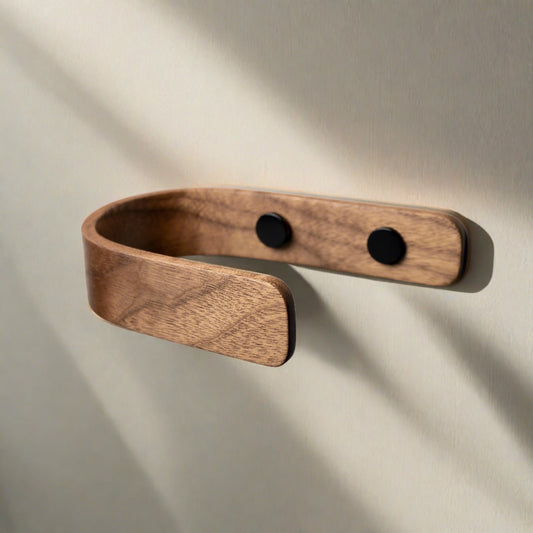
The answer lies in rigorous scientific testing methods that measure hardwood strength across multiple dimensions. At NOIR.DESIGN, understanding these properties guides our selection of premium hardwoods—Oak, Black Walnut, and Ash—for our watch stands, pen holders, and wall hooks.
Understanding Hardwood Strength: More Than Just "Hard"
Hardwood strength isn't a single property—it's a complex combination of characteristics that determine how wood performs under different stresses. The primary factors include:
- Density: The mass per unit volume, which generally correlates with strength
- Grain orientation: How wood fibres are arranged affects directional strength
- Moisture content: Dry wood is typically stronger than wet wood
- Natural compounds: Lignin and cellulose provide structural integrity
- Growth conditions: Slow-grown trees often produce denser, stronger wood
To accurately assess these properties, materials scientists and engineers employ several standardized testing methods.
The Janka Hardness Test: The Gold Standard
The Janka hardness test is the most widely recognized method for measuring a hardwood's resistance to wear and denting. This test has become the industry standard for comparing hardwood species.
How the Janka Test Works
The test measures the force required to embed a 0.444-inch (11.28 mm) steel ball halfway into a wood sample. The result is expressed in pounds-force (lbf) or newtons (N), providing a numerical value that indicates the wood's resistance to indentation.
The Testing Process:
- A standardized wood sample is prepared and conditioned to 12% moisture content
- A steel ball is pressed into the wood surface at a controlled rate
- The force required to embed the ball to half its diameter is measured
- Multiple tests are conducted on different grain orientations
- Results are averaged to provide the final Janka rating
Interpreting Janka Ratings

Janka Hardness Scale:
- Extremely Hard (2,000+ lbf): Brazilian Walnut (3,680), Hickory (1,820)
- Hard (1,200-2,000 lbf): Oak (1,360), Ash (1,320)
- Moderately Hard (800-1,200 lbf): Black Walnut (1,010), Cherry (995)
- Soft (Under 800 lbf): Pine (690), Cedar (350)
For home accessories and furniture, hardwoods in the 1,000-1,500 lbf range offer an ideal balance of durability and workability—which is why we work primarily with Oak, Ash, and Black Walnut.
Beyond Janka: Comprehensive Strength Testing
While the Janka test measures surface hardness, other tests evaluate how hardwood performs under different types of stress. Understanding these properties ensures we select woods that excel in real-world applications.
1. Bending Strength (Modulus of Rupture)
Bending strength measures a hardwood's ability to resist breaking when subjected to flexural stress—essentially, how much weight it can support before snapping.
The Test: A wood sample is supported at both ends while force is applied to the center until it breaks. The maximum load before failure determines the bending strength.
Why It Matters: This property is crucial for furniture legs, shelving, and any application where wood must support weight without sagging or breaking. Our coat racks and wall hooks rely on excellent bending strength to support coats and bags safely.
Our Woods:
- Oak: Excellent bending strength (14,300 psi)
- Ash: Superior bending strength (15,000 psi)
- Black Walnut: Good bending strength (14,600 psi)
2. Compression Strength
Compression strength assesses a hardwood's resistance to crushing forces applied perpendicular to the grain—how much weight it can support before being crushed.
The Test: A wood sample is compressed from the top until it fails. The maximum load it can withstand is recorded.
Why It Matters: This property is vital for applications where wood supports heavy loads, such as furniture legs, structural supports, or items that bear significant weight. Our watch stands benefit from high compression strength to maintain stability.
Our Woods:
- Oak: Excellent compression strength (6,760 psi)
- Ash: Very good compression strength (7,410 psi)
- Black Walnut: Good compression strength (7,580 psi)
3. Tensile Strength
Tensile strength measures a hardwood's ability to withstand pulling or stretching forces without breaking—essentially, how much tension it can handle before tearing apart.
The Test: A wood sample is gripped at both ends and pulled in opposite directions until it breaks. The force required to cause failure is measured.
Why It Matters: While less common in furniture applications, tensile strength is important for joints, connections, and any situation where wood experiences pulling forces. This property also relates to how well wood holds fasteners like screws and nails.
4. Shear Strength
Shear strength evaluates a hardwood's resistance to forces applied parallel to its surface—how well it resists sliding or deformation when lateral pressure is applied.
The Test: Lateral forces are applied to a wood sample to determine its resistance to deformation along the grain.
Why It Matters: This property is crucial for flooring, paneling, and any application where wood surfaces experience sliding forces. It also affects how well joints hold together under stress.
5. Impact Resistance
Impact resistance measures how well hardwood absorbs sudden shocks without cracking or breaking—its ability to withstand sudden impacts.
The Test: A weighted pendulum strikes a wood sample, and the energy absorbed before failure is measured.
Why It Matters: This property is particularly important for items that might be dropped or knocked, such as furniture and home accessories. High impact resistance means pieces can withstand accidental bumps without damage.
How We Apply Strength Testing to Our Craft

At NOIR.DESIGN, understanding hardwood strength properties guides every design decision:
Material Selection
We choose Oak, Black Walnut, and Ash because their strength profiles perfectly match our applications:
Oak: Exceptional hardness (1,360 lbf) and bending strength make it ideal for wall hooks and coat racks that must support weight reliably.
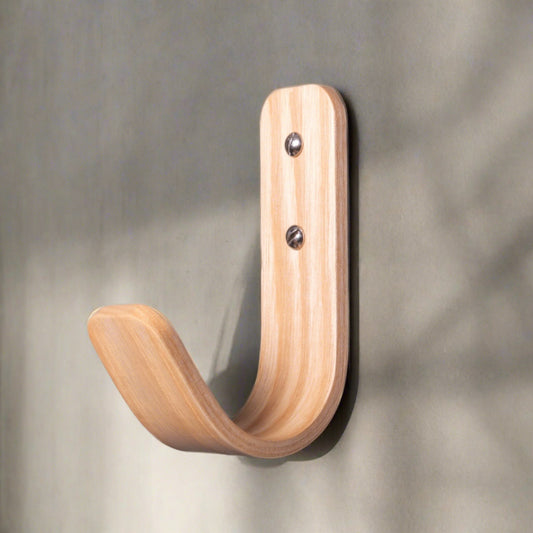
Ash: Superior bending strength (15,000 psi) makes it perfect for steam-bent designs where wood must curve without breaking. Its excellent compression strength ensures stability in watch stands.
Black Walnut: While slightly softer (1,010 lbf), Walnut's balanced strength properties and superior workability make it ideal for detailed pieces where precision matters more than extreme hardness.
Design Optimization
Understanding strength properties allows us to:
- Determine optimal thickness for structural integrity without excess weight
- Position grain orientation for maximum strength where needed
- Design joints that distribute stress effectively
- Create pieces that are both elegant and durable
Steam-Bending Considerations
Our signature steam-bending technique requires hardwoods with specific strength characteristics:
- Bending strength: Must be high enough to curve without breaking
- Compression strength: Needed to withstand compression on the inside of curves
- Tensile strength: Required to handle tension on the outside of curves
All three of our chosen hardwoods excel in these properties, allowing us to create the elegant curves that define our collections.
Real-World Performance vs. Lab Testing
While laboratory tests provide valuable data, real-world performance depends on additional factors:
Moisture Content
Wood strength varies significantly with moisture content. Properly dried and conditioned wood (around 6-8% moisture for indoor furniture) performs optimally. We carefully control moisture content throughout our crafting process.
Grain Orientation
Wood is much stronger along the grain than across it. Strategic grain orientation in design maximizes strength where it's needed most.
Finish and Protection
Our eco-friendly hardwax oil finishes not only enhance beauty but also provide protection that helps maintain wood strength over time by regulating moisture exchange.
Joint Construction
Even the strongest wood can fail if joints are poorly designed. Our steam-bent construction creates continuous grain flow, eliminating weak points that plague conventionally joined pieces.
Strength and Sustainability
Choosing hardwoods with appropriate strength properties contributes to sustainability:
- Longevity: Stronger woods create pieces that last generations, reducing replacement needs
- Efficient use: Understanding strength allows us to use less material while maintaining durability
- Reduced waste: Pieces that don't break or wear out prematurely don't end up in landfills
- Heirloom quality: Strength ensures pieces can be passed down through families
Choosing Hardwood Based on Strength Needs
Different applications require different strength profiles:
For High-Impact Areas
Choose: Oak or Ash
Why: High Janka ratings (1,320-1,360 lbf) resist denting from daily use
Best for: Wall hooks, coat racks, frequently handled items
For Display and Decorative Pieces
Choose: Black Walnut
Why: Moderate hardness (1,010 lbf) is sufficient; superior workability allows for fine detailing
Best for: Premium watch displays, executive desk accessories
For Curved or Bent Designs
Choose: Ash
Why: Exceptional bending strength (15,000 psi) allows for dramatic curves
Best for: Steam-bent designs, sculptural pieces, curved wall hooks
The Future of Hardwood Testing
As materials science advances, hardwood testing continues to evolve:
- Non-destructive testing: New methods assess strength without damaging samples
- Digital modeling: Computer simulations predict performance before physical testing
- Micro-level analysis: Understanding cellular structure reveals why some woods are stronger
- Sustainability metrics: Testing now includes environmental impact alongside physical properties
These advances help craftsmen make even more informed decisions about material selection and design optimization.
Strength Meets Beauty
The science of hardwood strength testing might seem purely technical, but it's fundamentally about creating pieces that endure. When you understand why Oak resists denting, why Ash bends beautifully, and why Walnut machines so precisely, you appreciate that strength and beauty aren't opposing forces—they're complementary qualities that define exceptional craftsmanship.
Every watch stand, pen holder, and wall hook we create benefits from centuries of materials science and testing methodology. This knowledge ensures that the pieces you bring into your home aren't just beautiful—they're built to become heirlooms.
Explore our collection of handcrafted pieces in Oak, Black Walnut, and Ash—each selected for its proven strength properties and exceptional beauty. Every piece is handcrafted in England using hardwoods that have been rigorously tested and proven to last for generations.